AI · Oct 28, 2026
RTX Spark laptops get open speech models and a dial for background agentsGTC Berlin recap: Huang sells Europe a full AI stack and calls agent security job one
· Updated · Signal Desk newsroom
Analysis of reporting by NVIDIA Blog. How we work
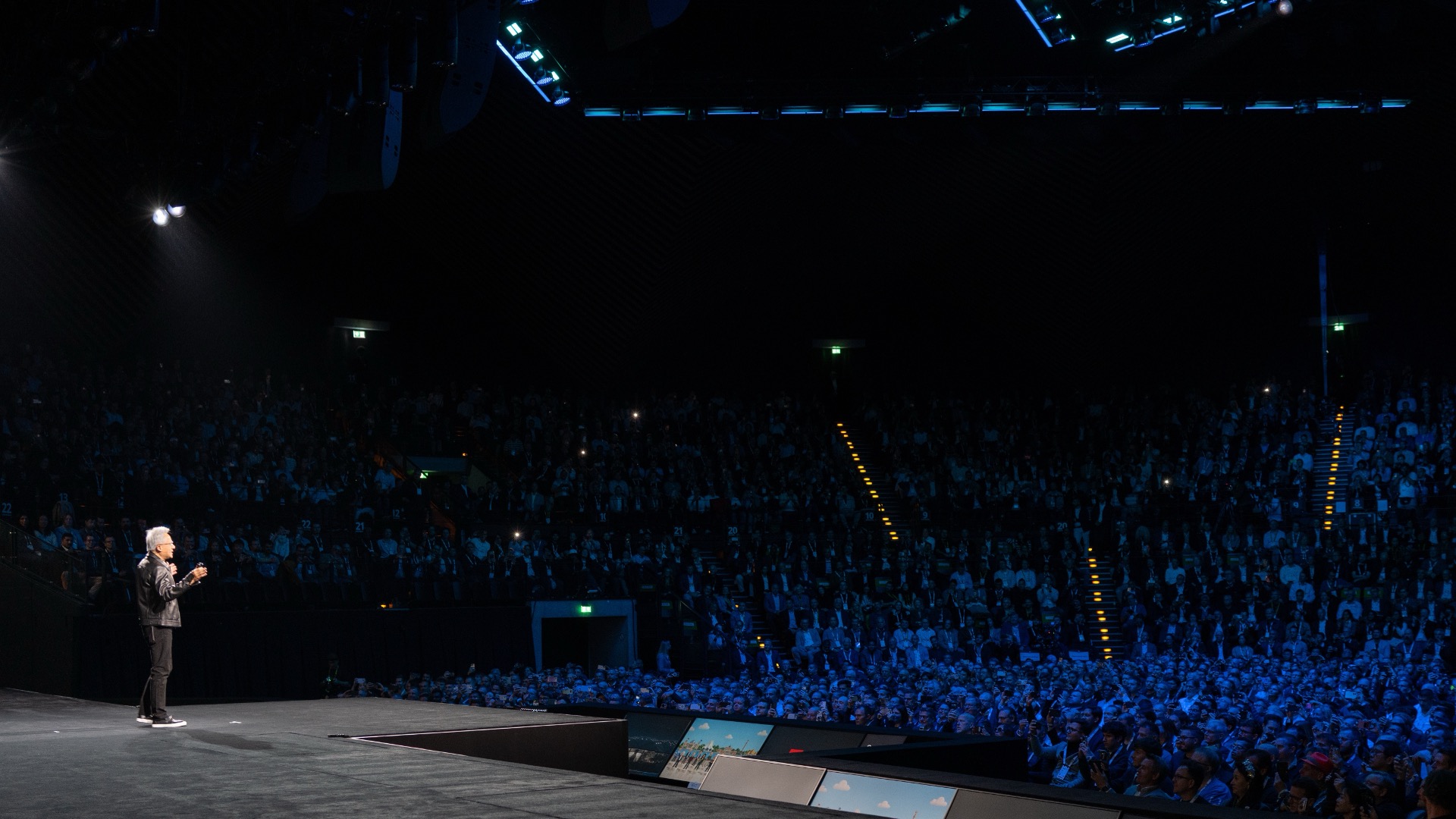
Jensen Huang’s Berlin keynote ran Nvidia’s stack top to bottom, from Vera Rubin in full production and 14-day DSX PODs to open models, telecom, cars and a reference humanoid, capping a week of nearly $10 billion in European commitments. The sharpest message was least-privilege agents.
Key takeaways
- Nvidia says it committed nearly $10 billion to Europe’s technology ecosystem and works with more than 12,000 partners there.
- Huang described agents as model, harness, sandbox, knowledge and tools, with minimal, monitored privileges.
- Nvidia says DSX POD can cut onsite deployment from six months to 14 days once site utilities are ready.
- It claims its DSX AI Factory Platform can cut cooling water use by up to 100% and power by up to 30% for the same output.
- Applied examples included Lila Sciences drug design, Siemens digital twins and adaptive radiation therapy with Siemens Healthineers.
What Huang presented
At GTC Berlin, Nvidia’s chief executive framed Europe as ready to produce AI rather than consume it, capping a week in which the company says it committed nearly $10 billion to Europe’s technology ecosystem and works with more than 12,000 partners. The keynote at Berlin’s Tempodrom, part of a three-day event with more than 100 sessions, covered Vera Rubin in full production, the modular DSX POD reference design, open models, an agent knowledge layer (Agent Knowledge Foundation), telecom, healthcare, cars, a reference humanoid and RTX Spark laptops (local AI lineup). Other announcements included a first commercial phone call on T-Mobile’s network with Nokia, wider adoption of the Hyperion automotive platform by Volvo Cars and others, and the Agile ONE SN reference humanoid expected next year. Hugging Face’s Microduck robots also drew attention (Microduck preorders).
Least privilege for agents
Much of the keynote focused on agents and containing them. Huang described an agent as five parts: a model, a harness that orchestrates work and memory, a sandbox that isolates the harness, knowledge and tools. He argued agent privileges should be minimal, monitored and adjusted each time an agent launches. Nvidia’s product answer is the OpenShell Reference Architecture, an open-source, policy-controlled runtime with kernel-level sandboxing between an agent and the systems it can affect, backed by cloud partners (cloud partners). Naming least privilege as the default sets an agenda for enterprise buyers; independent security reviews of the sandboxing will show whether it holds in practice.
Infrastructure claims and sovereignty
Nvidia says DSX POD, prebuilt Vera Rubin AI factories in modular containers, can shrink onsite deployment from six months to 14 days once site utilities are ready, and that its DSX AI Factory Platform can cut cooling water use by up to 100% and deliver the same output with up to 30% less power. These are vendor claims with caveats built in, notably the utilities condition; power and grid access, more than containers, slow European data centers (plug-in data centers).
Huang urged companies to post-train open models like Nemotron on their own data, calling the result ‘sovereign intelligence.’ Open models with reproducible data and scripts are useful, but sovereignty on one American company’s chips, libraries and reference designs is narrower than the word suggests. The applied examples were concrete: agents at Lila Sciences helping design a potential B-cell lymphoma therapy, Siemens testing production plans in a digital twin, and adaptive radiation therapy with Siemens Healthineers that tracks a changing tumor during treatment. Real-time radiation targeting in particular requires clinical validation and regulatory review well beyond a keynote demonstration. More in our Nvidia coverage, AI agents coverage and robotics coverage.
Who feels it
- European enterprises
- A full reference stack lowers agent deployment barriers and concentrates supply.
- Data center builders
- Faster builds, once power and utilities are in place.
- Healthcare and life sciences
- Promising applications that require rigorous validation.
- Automakers and robotics researchers
- Shared platforms for autonomy via Hyperion and a reference humanoid.
What to watch
- Real DSX POD deployments against European grid constraints.
- Independent security reviews of OpenShell.
- Regulatory review of the adaptive radiotherapy work.
- How much of the nearly $10 billion becomes operating capacity.
FAQ
What did Nvidia announce at GTC Berlin 2026?
Vera Rubin in full production, DSX POD modular data centers, open models, an agent knowledge layer, OpenShell, telecom and automotive news and a reference humanoid.
How much has Nvidia committed to Europe?
Nearly $10 billion, according to Nvidia.
What did Huang say about agent security?
Agents should run with minimal, monitored privileges adjusted each time they launch.
How fast can a DSX POD deploy?
Nvidia says 14 days onsite once site utilities are ready.
Companies: NVIDIA
More on NVIDIA
AI · Sep 30, 2026
The four rules in the White House AI commitment, and the missing fifth: penaltiesAI · Nov 5, 2026
NVIDIA’s four open Cosmos 3 Nano models let robot and driving teams simulate worlds that reactAI · Oct 7, 2026
Microsoft prices its first RTX Spark PCs; the agent sandbox coming to all Windows 11 users may matter moreAI · Nov 9, 2026
Nvidia’s Korean startup bets span interconnect, open models, robot hands and document AI