AI · Oct 28, 2026
RTX Spark laptops get open speech models and a dial for background agentsNscale’s power test and a hardware agent-safety design stand out in Nvidia’s cloud roll call
· Updated · Signal Desk newsroom
Analysis of reporting by NVIDIA Blog. How we work
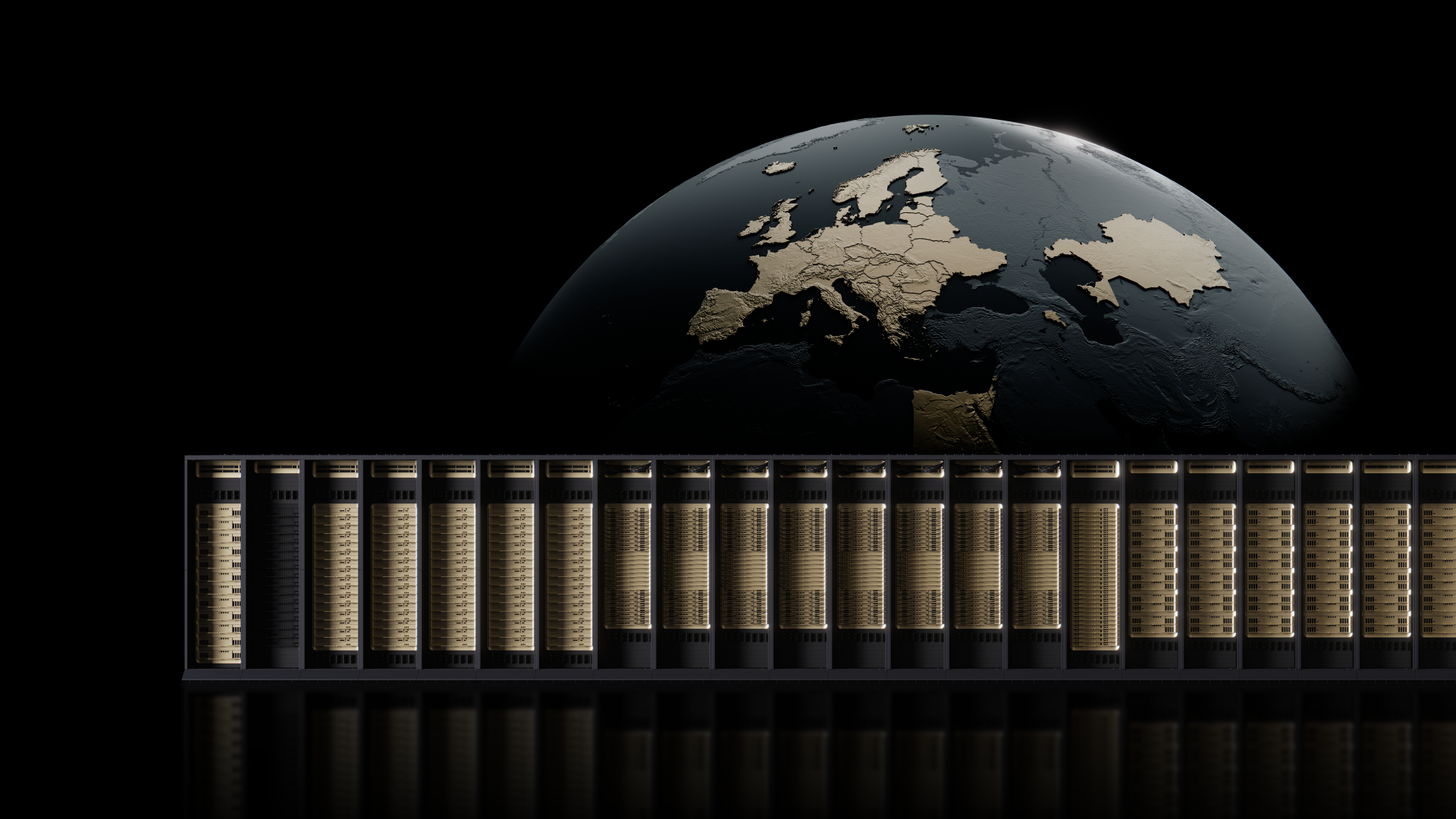
Nvidia showcased partners adding regional AI capacity across Europe, the Nordics, Africa and Central Asia. Two items matter most: Nscale’s report of 37% more GPUs in the same power budget using DSX MaxLPS, and an OpenShell Reference Architecture that enforces agent limits in hardware.
Key takeaways
- Nscale, Crusoe, Nebius, Mistral, Fireworks with Era4, Verda and others announced Nvidia-based expansions, many aimed at Vera Rubin.
- Nscale reports DSX MaxLPS allowed 37% more GPUs and nearly 50% higher inference throughput in the same power budget on GB300 NVL72 tests.
- The OpenShell Reference Architecture splits agent inference, tool use and enforcement across Vera Rubin, Vera CPUs and BlueField-4 DPUs.
- Baseten and CodeRabbit raised code-review routing agreement from 75.8% to 80.7% with a fine-tuned Nemotron, halving estimated cost.
- Mistral says Large 4 was trained on 3,800 Grace Blackwell GPUs in its own European data centers.
What Nvidia showcased
Nvidia used GTC Berlin to showcase cloud partners across Europe, the Nordics, Africa and Central Asia adding regional AI capacity. Nscale, Crusoe, Nebius, Mistral, Fireworks with Era4, Verda and others announced expansions tied to Nvidia hardware, much of it aimed at the coming Vera Rubin platform; Mistral’s Vera Rubin delivery is planned for 2027. Nebius has adopted Nvidia Groq 3 LPX hardware alongside Vera Rubin NVL72 for low-latency inference (Groq 3 LPX) and runs a physical AI workbench used by robotics firms including Rhoda AI, RoboForce and Sereact.
Much of the post is a capacity roll call framed as sovereignty, though nearly every piece runs on one American company’s chips, networking and software. Choosing where data sits is real control; choosing whose stack to depend on is a separate question the post does not address. The same theme ran through Nvidia’s pitches to European governments (public sector open models).
The power result
Nscale reports that in tests on GB300 NVL72 systems, Nvidia’s DSX MaxLPS power software allowed 37% more GPUs and nearly 50% higher aggregate inference throughput within the same power budget. Europe’s AI build-out is constrained more by electricity than ambition, and extracting materially more inference from the same grid connection changes how many projects are viable. The figure comes from Nscale’s own tests and needs independent confirmation, but it is the most consequential number in the post (DSX and power).
Smaller proof points favor open models. Baseten and CodeRabbit fine-tuned Nemotron 3.5 Lightning for code-review routing, moving routing agreement from 75.8% to 80.7% while cutting estimated inference costs in half for that workload. Mistral says its Large 4 model was trained on 3,800 Grace Blackwell GPUs in its own European data centers, a version of sovereignty built on local model developers rather than only local hosting.
Enforcing agent limits in silicon
Nvidia also announced an OpenShell Reference Architecture, backed by many cloud partners, to put hard limits on what AI agents can access and do. It splits duties across hardware: Vera Rubin for inference, Vera CPUs running OpenShell for agent tool use, and BlueField-4 DPUs running Nvidia Sentry for enforcement. It builds on the Open Agent Safety Platform Nvidia launched in September (agent safety platform). Enforcing boundaries below the software layer, where a manipulated prompt cannot reach, is a sound idea that could make it easier to justify agents in production. It also ties safety to buying more Nvidia components, which will shape who can afford well-contained agents. More in our Nvidia coverage, AI agents coverage and cybersecurity coverage.
Who feels it
- European enterprises
- More regional capacity and data-location choice, on a concentrated stack.
- Agent developers
- Hardware-enforced boundaries could ease production deployment.
- Grid and energy planners
- Efficiency gains could ease, not remove, power strain.
What to watch
- Independent DSX MaxLPS results beyond Nscale’s tests.
- First deployments of the OpenShell Reference Architecture with Sentry.
- Vera Rubin delivery timelines across European partners.
- EU policymakers questioning single-vendor sovereignty.
FAQ
What did Nscale report about DSX MaxLPS?
37% more GPUs and nearly 50% higher inference throughput within the same power budget, in its own GB300 NVL72 tests.
What is the OpenShell Reference Architecture?
An Nvidia design that separates agent inference, tool use and hardware enforcement to limit what agents can do.
Where did Mistral train Large 4?
On 3,800 Grace Blackwell GPUs in its own European data centers, it says.
Is Europe’s AI cloud sovereign?
Data location is local, but most capacity depends on Nvidia hardware and software.
Companies: NVIDIA
More on NVIDIA
AI · Sep 30, 2026
The four rules in the White House AI commitment, and the missing fifth: penaltiesAI · Nov 5, 2026
NVIDIA’s four open Cosmos 3 Nano models let robot and driving teams simulate worlds that reactAI · Oct 7, 2026
Microsoft prices its first RTX Spark PCs; the agent sandbox coming to all Windows 11 users may matter moreAI · Nov 9, 2026
Nvidia’s Korean startup bets span interconnect, open models, robot hands and document AI