AI · Oct 28, 2026
RTX Spark laptops get open speech models and a dial for background agentsGrid giants sign on to Nvidia’s DSX as power, not chips, gates AI data centers
· Updated · Signal Desk newsroom
Analysis of reporting by NVIDIA Blog. How we work
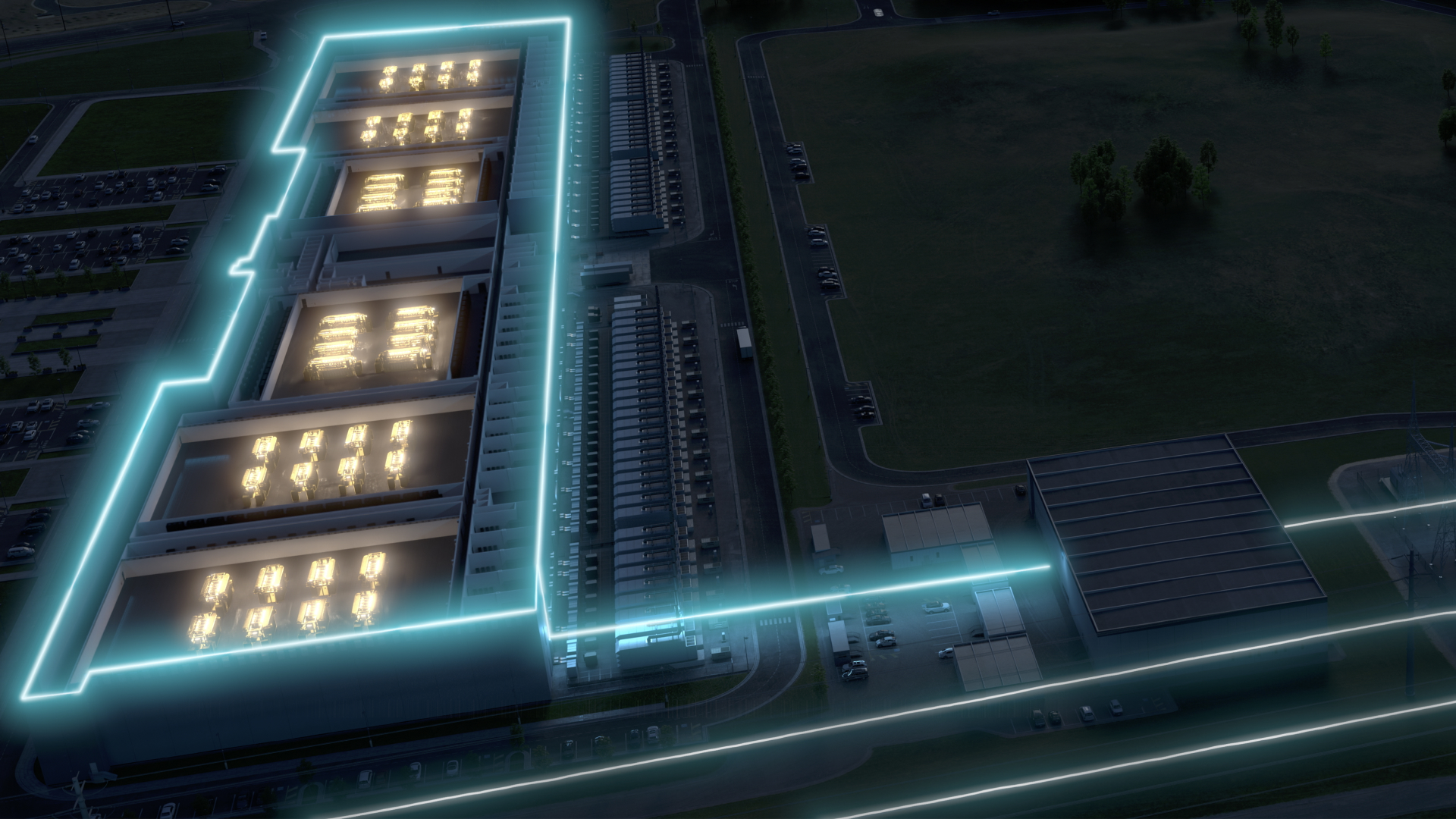
Nvidia says power is now AI infrastructure’s biggest bottleneck, citing more than $300 billion in backlogged equipment and over 200 gigawatts in U.S. interconnection queues. GE Vernova, Hitachi Energy, Schneider Electric and Siemens Energy are aligning with its DSX platform.
Key takeaways
- Nvidia cites more than $300 billion in backlogged equipment and over 200 GW of projects waiting in U.S. interconnection queues.
- DSX aims to plan, simulate and run the grid connection, building and racks as one system.
- GE Vernova, Hitachi Energy, Schneider Electric with AVEVA and ETAP, and Siemens Energy announced aligned work.
- Phaidra reports about 10% more compute in the same power envelope; Emerald AI’s up-to-100 GW figure is modeled.
- A ‘DSX Ready’ label puts Nvidia in the role of setting design requirements for power equipment.
What Nvidia announced
Nvidia says power has become the single biggest bottleneck in AI infrastructure, pointing to more than $300 billion in backlogged equipment and over 200 gigawatts of projects waiting in U.S. interconnection queues, the waiting lists for new power projects and large loads to connect to the grid. Its answer is DSX, a platform meant to plan, simulate and operate the grid connection, the building and the racks as one system. Components named include DSX Sim for simulation, DSX Flex for syncing demand with grid conditions, and DSX MaxLPS and DSX Exchange for efficiency and data sharing.
GE Vernova, Hitachi Energy, Schneider Electric with AVEVA and ETAP, and Siemens Energy all announced work aligned with it, and Hitachi Energy’s battery storage qualified as ‘DSX Ready.’ It extends Nvidia’s push to make AI data centers arrive like manufactured goods (DSX POD) and to squeeze more output from stranded rack power (DSX MaxLPS).
Flexible load, measured and modeled
The core idea is to treat an AI facility as a load that can flex with grid conditions rather than a fixed block of demand served at all times. That could bring capacity online without waiting years for new transmission, and simulating generators, cooling and switchgear together before construction is sound practice. There is early evidence: Emerald AI’s Conductor has taken Silicon Valley Power demand signals across thousands of Nvidia GPUs, with more than 200 events where power dropped on cue (megawatts to tokens).
The headline figures differ in quality. Phaidra reports about 10% more compute inside the same power envelope, a specific and meaningful claim. Emerald AI’s figure of up to 100 gigawatts unlocked on the existing U.S. grid is described as modeled, a ceiling from a model rather than delivered capacity. Google, Nvidia and Anthropic have backed Emerald AI’s demand-response coalition on that premise (Emerald AI coalition).
Whose metric, whose costs
‘Tokens per watt’ is the data center’s metric. Utilities and ratepayers care about reliability and who pays for grid upgrades. If flexible AI facilities genuinely shed load during peaks, everyone benefits; if flexibility mainly helps projects move up interconnection queues while households absorb grid costs, the politics could turn quickly. Utilities will want proof that flexibility appears when the grid actually needs it, and regulators will face questions about whether to credit flexible load in interconnection decisions.
There is also a concentration point. When transformer and switchgear makers design to a chip company’s reference architecture, here tied to the Vera Rubin generation, one vendor’s roadmap begins to shape how substations and storage are specified. That can speed standardization, and Nvidia has opened its Vera Rubin rack designs through the Open Compute Project (Vera Rubin at OCP), but it deserves scrutiny. More in our Nvidia coverage and AI tools coverage.
Who feels it
- Utilities
- Flexible AI loads could ease peak stress, if the flexibility is proven in real events.
- Data center developers
- Joint grid-and-facility simulation could shorten planning and reduce stranded capacity.
- Energy equipment makers
- Aligning with Nvidia’s designs may become a de facto spec.
- Ratepayers and regulators
- Cost-sharing for grid-aware AI facilities becomes a live policy question.
What to watch
- DSX Flex results during actual grid peak events.
- Any utility or regulator crediting flexible AI load in interconnection.
- Independent validation of Emerald AI’s modeled 100 GW figure.
- More energy hardware earning DSX Ready status.
FAQ
What is Nvidia DSX?
A platform to plan, simulate and operate an AI data center’s grid connection, building and racks as one system.
Why is power the AI bottleneck?
Nvidia cites more than $300 billion in backlogged equipment and over 200 GW waiting in U.S. interconnection queues.
Which energy companies are involved?
GE Vernova, Hitachi Energy, Schneider Electric with AVEVA and ETAP, and Siemens Energy.
Is the 100 GW figure real capacity?
No. Emerald AI’s up-to-100 GW figure is modeled, not delivered.
Companies: NVIDIA
More on NVIDIA
AI · Nov 5, 2026
NVIDIA’s four open Cosmos 3 Nano models let robot and driving teams simulate worlds that reactAI · Oct 7, 2026
Microsoft prices its first RTX Spark PCs; the agent sandbox coming to all Windows 11 users may matter moreAI · Nov 9, 2026
Nvidia’s Korean startup bets span interconnect, open models, robot hands and document AIAI · Nov 8, 2026
Nvidia’s Dynamo recipes speed four Korean open models to production, tuned for B200s