AI · Oct 28, 2026
RTX Spark laptops get open speech models and a dial for background agentsNvidia’s desk-side AI lineup fills in, from RTX Spark laptops to DGX Station
· Updated · Signal Desk newsroom
Analysis of reporting by NVIDIA Blog. How we work
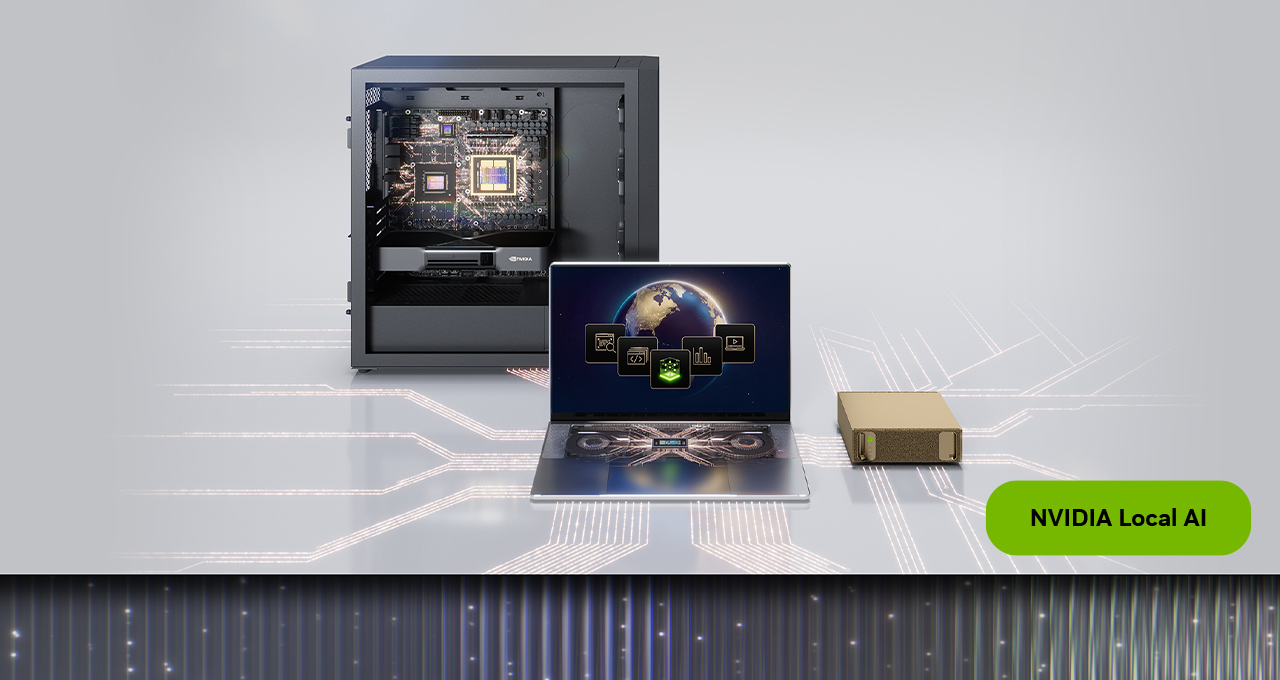
At GTC Berlin, Nvidia laid out its local AI stack: RTX Spark laptops, a 64GB DGX Spark shipping October 23, clusters of up to eight Sparks, and DGX Station for teams, plus management integrations and open-model support. Data staying on-site is the strongest argument; the software stack is still Nvidia’s.
Key takeaways
- A 64GB DGX Spark ships from partners on October 23, and up to eight DGX Sparks can be clustered.
- DGX Station, quoted at 748GB of coherent memory and up to 20 petaflops, gets a Windows version in December; Nvidia says it can serve more than 30 users.
- RTX Spark laptops launched October 16 with up to 128GB of unified memory and 1 petaflop of AI compute.
- Nvidia claims Recursive’s open Flint coding model runs at over 220 tokens per second on a 64GB RTX Spark.
- DGX Station gains seven enterprise management integrations, including Intune, Splunk and Tanium.
What Nvidia showed
Nvidia used GTC Berlin to lay out its local AI lineup: RTX Spark laptops for personal agents on Windows, a new 64GB DGX Spark shipping from partners on October 23 (DGX Spark 64GB), clustering of up to eight DGX Sparks, and DGX Station for teams, with a Windows version due in December. Software included a Model Launcher in Nvidia Sync, seven enterprise management integrations for DGX Station, robotics reference workflows and day-zero support for many open models. Nvidia says RTX Spark launched October 16 with up to 128GB of unified memory and 1 petaflop of AI compute (RTX Spark); DGX Station is quoted at 748GB of coherent memory and up to 20 petaflops, and an eight-unit DGX Spark cluster at 1TB of unified memory. Laptops from ASUS, Dell, HP, Lenovo, Microsoft and MSI are listed, with Acer coming.
The significance is less any single machine than a stack for running capable agents on hardware an organization owns, ranging from a 4GB voice model to a desk-side machine Nvidia says can serve more than 30 users.
Who holds the data
Local inference changes who holds the data. Underdog, a desktop agent app Nvidia highlighted, says it runs models entirely on device so personal data never leaves the PC. For lawyers, clinicians, engineers handling export-controlled designs or anyone unwilling to route an inbox through someone else’s servers, that is a substantive benefit if apps hold to their claims. Enterprise integrations with tools such as Intune, Splunk and Tanium may matter more than raw speed, because they make desk-side AI look like any other managed endpoint.
Recursive’s Flint, an Apache 2.0 open-weights coding model with 40 billion parameters and 2.5 billion active, featured prominently. Nvidia claims over 220 tokens per second on a 64GB RTX Spark, while Recursive separately reported about 131 tokens per second on an M4 Pro MacBook Pro (Recursive’s Flint); its maker says automatically generated kernels sped generation by 55% without changing weights. All are vendor figures awaiting independent benchmarks.
Local is not the same as independent
Every performance figure here comes from Nvidia’s own blog at its own conference. And the software layer, from Sync to Model Launcher to Cloud Functions on DGX Station, is Nvidia’s, so owning the hardware does not mean owning the stack. There is a security dimension too: many RTX Spark laptops ship with unlocked bootloaders to encourage tinkering, and agents on a desk with access to local files and tools need careful permissioning. Moving agents closer to sensitive data reduces some risks and creates others.
If the approach scales, the market could split, with frontier models in the cloud and a growing share of everyday agent work, such as coding, drafting and robotics training loops, on machines in the office. That could pressure per-token cloud pricing for routine tasks and is a healthier balance than total cloud concentration, provided open weights stay open. More in our Nvidia coverage, enterprise coverage and AI agents coverage.
Who feels it
- Developers
- Fast local coding models and easier clustering cut metered cloud costs.
- Enterprise IT
- Management integrations make desk-side AI a managed endpoint.
- Privacy-sensitive users
- On-device agents as an alternative to cloud services.
- Cloud AI providers
- Some routine inference may shift to owned hardware.
What to watch
- Independent benchmarks of Flint’s speed and coding scores.
- DGX Station for Windows shipping on schedule in December.
- Security guidance or incidents involving local agents.
- Uptake of the 64GB DGX Spark after October 23.
FAQ
When does the 64GB DGX Spark ship?
From partners on October 23, according to Nvidia.
What is DGX Station?
A desk-side Nvidia system quoted at 748GB of coherent memory and up to 20 petaflops, with a Windows version due in December.
How fast is Flint on RTX Spark?
Nvidia claims over 220 tokens per second on a 64GB RTX Spark; these are vendor figures.
Why run AI agents locally?
Data can stay on the device or premises, which matters for privacy-sensitive work.
Companies: NVIDIA
More on NVIDIA
AI · Sep 30, 2026
The four rules in the White House AI commitment, and the missing fifth: penaltiesAI · Nov 5, 2026
NVIDIA’s four open Cosmos 3 Nano models let robot and driving teams simulate worlds that reactAI · Oct 7, 2026
Microsoft prices its first RTX Spark PCs; the agent sandbox coming to all Windows 11 users may matter moreAI · Nov 9, 2026
Nvidia’s Korean startup bets span interconnect, open models, robot hands and document AI