AI · Oct 28, 2026
RTX Spark laptops get open speech models and a dial for background agentsNvidia’s Agent Knowledge Foundation targets what enterprise agents don’t know
· Updated · Signal Desk newsroom
Analysis of reporting by NVIDIA Blog. How we work
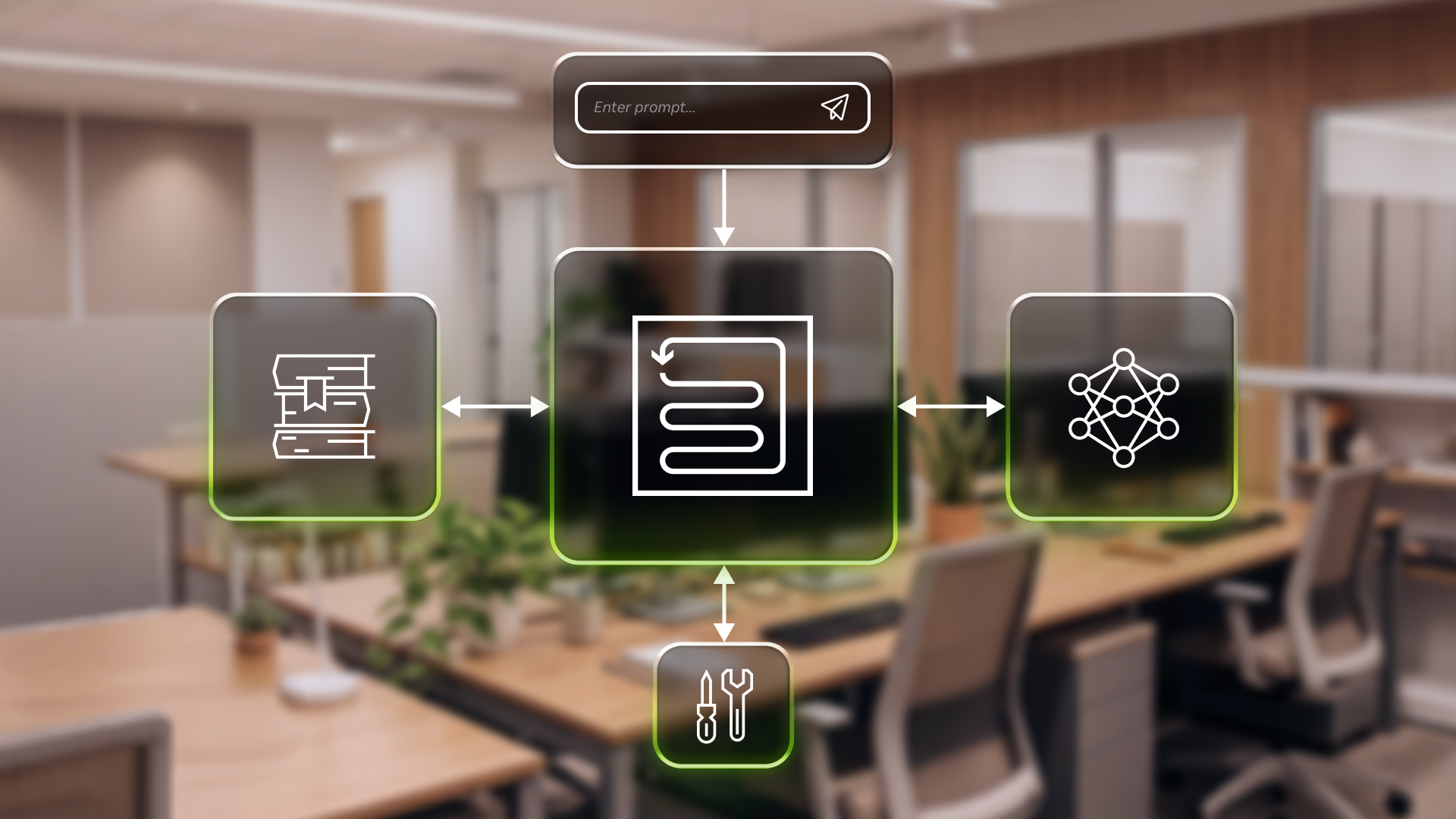
Nvidia expanded its open-source Agent Toolkit with an Agent Knowledge Foundation combining CUDA-X libraries, an Auto-Ontology library, Nemotron Retriever and Kumo models, plus the OpenShell runtime. Palantir, Databricks and Snowflake are integrating it; results so far are vendor-reported.
Key takeaways
- The Agent Knowledge Foundation combines CUDA-X libraries, a new Auto-Ontology library, Nemotron Retriever and Kumo open models.
- Auto-Ontology maps raw company data into business concepts and relationships.
- Nvidia’s supply chain team uses it through Palantir Foundry; Databricks pairs Kumo Anomaly with Genie Ontology; Snowflake offers Kumo in notebooks.
- Nvidia cites SAP’s fine-tuned reranker running nearly 3x faster and ServiceNow cutting latency by nearly a quarter.
- OpenShell provides a secure runtime boundary for agents with deep data access.
What Nvidia announced
Nvidia expanded its open-source Agent Toolkit with a new Agent Knowledge Foundation, built from CUDA-X libraries, a new Auto-Ontology library, Nemotron Retriever and a family of Kumo open models for tabular, relational, time-series and forecasting work, including Kumo Relational (Kumo Relational) and Kumo Forecast (Kumo Forecast). Alongside sit OpenShell as a secure runtime and NemoClaw blueprints for building and improving agents. The practical promise is that companies can point agents at their data without moving it, rebuilding workflows or changing governance controls.
Named builders include AWS, ClickHouse, Cloudera, Cohesity, Dassault Systèmes, Dell, Elastic, Exa, IBM, NetApp, Oracle, Perplexity, Starburst and VAST Data, and Zoom is using Nemotron Retriever for document understanding and search. The announcement was part of Nvidia’s GTC Berlin slate.
Grounding agents in the business
Many enterprise agents fail not because the model is weak but because it does not understand the business: which table means customers, how orders relate to products, what a forecast should rest on. Auto-Ontology, which maps raw company data into familiar business concepts and their relationships, targets that gap. Nvidia’s own supply chain organization uses the foundation through Palantir’s Foundry, Ontology and AIP, extending earlier work codifying allocation decisions (Nemotron with Palantir). Databricks pairs Kumo Anomaly with its Genie Ontology, and Snowflake offers Kumo models in its notebooks.
On retrieval, Nvidia cites Amazon OpenSearch Service improving relevance with virtually no added latency, SAP’s fine-tuned reranker running nearly 3x faster and ServiceNow cutting latency by nearly a quarter. These are vendor-reported figures; customer-published results would carry more weight, as would evidence of how Auto-Ontology handles messy real-world schemas.
Platform strategy and risk
Nvidia sells the chips and now wants the knowledge layer and runtime between agents and everything they touch. Open source lowers adoption barriers and makes the stack feel neutral, but CUDA-X libraries run best on Nvidia hardware. That is how platforms are built, and enterprises should know which parts of their agent architecture they are standardizing on, including whether Kumo models run competitively elsewhere.
An agent that understands company data well enough to predict outcomes and suggest decisions can also expose, misuse or misinterpret that data at scale. Nvidia pairs the knowledge layer with OpenShell’s runtime boundary, part of its Open Agent Safety Platform (in-silicon agent monitoring), and the key test is whether governance keeps pace when agents move from answering questions to acting. More in our Nvidia coverage, AI agents coverage and enterprise coverage.
Who feels it
- Enterprises
- A shared toolkit could shorten pilots and deepen vendor dependence.
- Data platforms
- Nvidia models become features inside Palantir, Databricks and Snowflake.
- Developers
- Free building blocks for prediction and retrieval.
- Security and governance teams
- Higher stakes on runtime boundaries holding.
What to watch
- Customer-published retrieval speed and accuracy results.
- Auto-Ontology on messy real-world schemas.
- Kumo model performance on non-Nvidia hardware.
- Incidents or audits involving agents acting on sensitive data.
FAQ
What is Nvidia’s Agent Knowledge Foundation?
An open-source set of libraries and models for grounding enterprise agents in company data without moving it.
What does Auto-Ontology do?
Maps raw company data into business concepts and their relationships.
Who is integrating it?
Palantir, Databricks, Snowflake and many others, including AWS, Oracle and IBM.
Are the performance gains verified?
No. Figures such as SAP’s 3x faster reranker are vendor-reported.
Companies: NVIDIA
More on NVIDIA
AI · Sep 30, 2026
The four rules in the White House AI commitment, and the missing fifth: penaltiesAI · Nov 5, 2026
NVIDIA’s four open Cosmos 3 Nano models let robot and driving teams simulate worlds that reactAI · Oct 7, 2026
Microsoft prices its first RTX Spark PCs; the agent sandbox coming to all Windows 11 users may matter moreAI · Nov 9, 2026
Nvidia’s Korean startup bets span interconnect, open models, robot hands and document AI