AI · Oct 28, 2026
RTX Spark laptops get open speech models and a dial for background agentsStormScope EU brings 10-minute AI nowcasts to Europe’s insurers and energy firms
· Updated · Signal Desk newsroom
Analysis of reporting by NVIDIA Blog. How we work
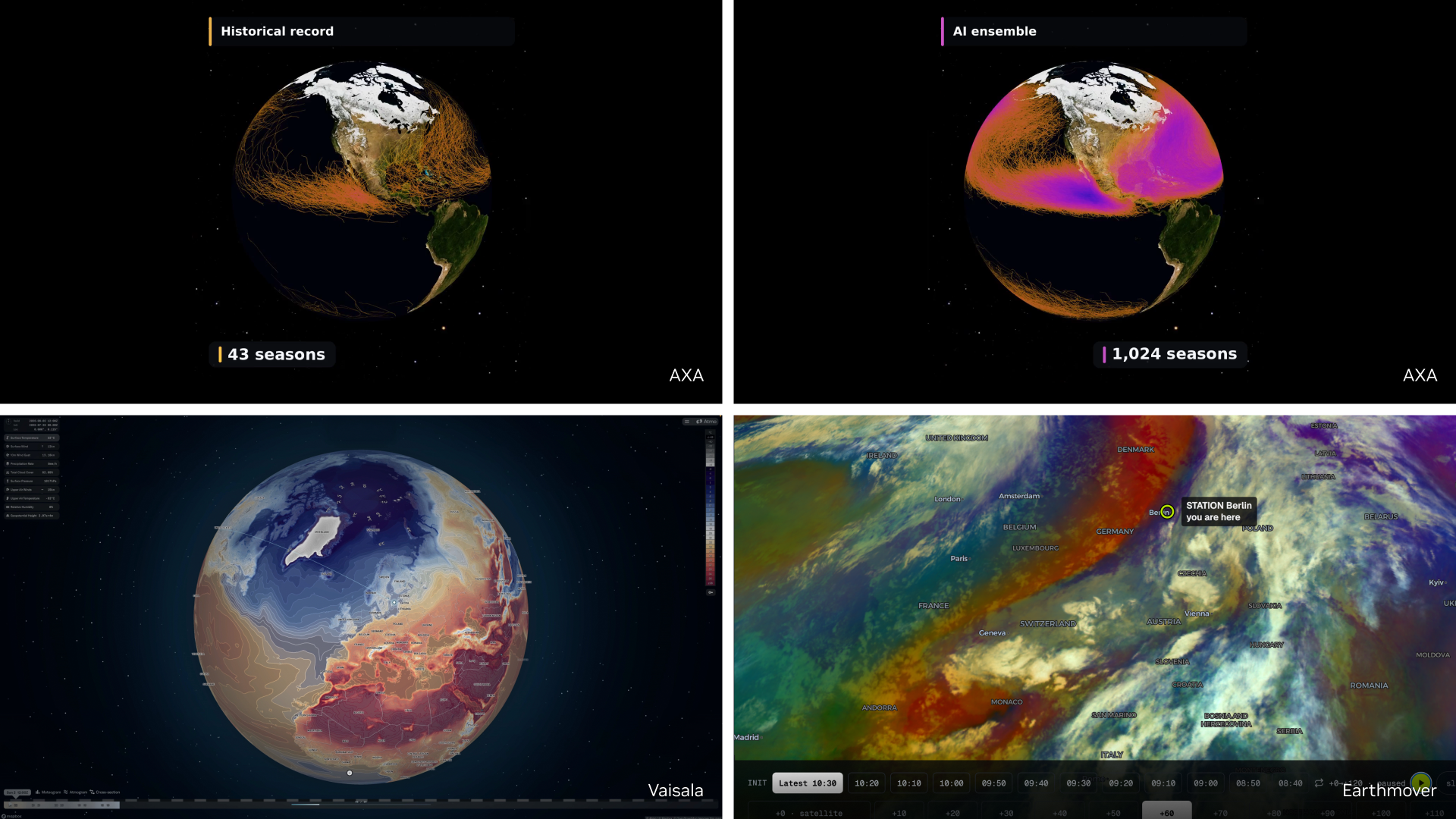
Nvidia added StormScope EU to its open Earth-2 weather models, forecasting cloud conditions from EUMETSAT satellite data every 10 minutes. AXA, Vaisala Xweather, TotalEnergies, Space42 and the University of Manchester are adapting the models, mostly at the evaluation stage.
Key takeaways
- StormScope EU predicts evolving cloud conditions across 16 Meteosat channels at 10-minute intervals, trained on European data.
- AXA uses FourCastNet 3 to study cyclone risk across more than 1,000 simulated seasons.
- University of Manchester researchers adapted CorrDiff for U.K. air quality and ran it on desktop DGX Spark machines.
- TotalEnergies is evaluating solar nowcasts at two sites; Vaisala is adapting StormScope with lightning data.
- Space42 produces uncertainty maps alongside radar-based height estimates.
What Nvidia released
Nvidia added StormScope EU to Earth-2, its family of open AI weather and climate models and tools. The short-term forecasting model is trained on European data and uses EUMETSAT satellite observations to predict evolving cloud conditions across 16 Meteosat channels at 10-minute intervals. At GTC Berlin, Nvidia showed a live StormScope EU demo built with Earthmover that refreshes as new satellite observations arrive every 10 minutes. Earth-2 also includes CorrDiff, which adds local detail to coarse data, and the PhysicsNeMo framework for customization.
Global forecasts show the storm; decisions about solar output, shipping and insured property depend on what happens over one valley in the next hour. That local, short-range layer is where these tools are aimed, and where the first adopters, insurers, energy producers and forecasters, have money at stake. It is part of a broader GTC Berlin slate built around open models that run near the data (Cosmos world models).
Who is adapting the models
AXA is using FourCastNet 3 to study cyclone risk across more than 1,000 simulated seasons, beyond the historical record, valuable for understanding tail risk. Vaisala Xweather is adapting StormScope with its lightning data, showing incumbents blending open models with proprietary observations rather than being displaced. TotalEnergies is evaluating solar nowcasts at two photovoltaic sites. Space42 produces uncertainty maps alongside its radar-based height estimates. University of Manchester researchers adapted CorrDiff for U.K. air-quality modeling, trained it on the Isambard-AI supercomputer, then ran it locally on desktop-class DGX Spark machines, moving environmental modeling from national infrastructure to a lab bench (DGX Spark clusters).
Publishing these as open models that organizations can retrain with their own data is a different pattern from a single black-box forecast sold by subscription, and widens who can do this work.
Verification, uncertainty and pricing
Most of what is described is still exploration, and the proof will be seasons of verified forecasts compared with operational European services. AI forecasts can look confident where they are weakest, so uncertainty estimates like Space42’s should become standard output rather than a research extra.
The insurance case also carries a consumer dimension. Simulated seasons beyond the historical record are how catastrophe and pricing models get built; if AI-generated scenarios begin to drive premiums, the assumptions inside those simulations matter to policyholders, and insurers will face questions about disclosure. Nvidia has framed related climate work as both a clean-energy and a grid story (Nvidia AI for clean energy). More in our Nvidia coverage and research coverage.
Who feels it
- Insurers
- Sharper catastrophe models, with transparency questions if they drive pricing.
- Energy producers
- Sub-hourly solar forecasts, still at evaluation stage.
- Researchers and agencies
- Open models on desktop systems lower the cost of local environmental modeling.
- Commercial forecasters
- Incumbents blend open models with proprietary observations.
What to watch
- Published verification of StormScope EU forecast skill.
- Insurer disclosure of AI-simulated scenarios in pricing.
- Results from TotalEnergies’ photovoltaic trials.
- Uncertainty estimates as standard Earth-2 output.
FAQ
What is StormScope EU?
An open Nvidia Earth-2 model that forecasts cloud conditions over Europe from EUMETSAT satellite data at 10-minute intervals.
Who is using Earth-2 in Europe?
AXA, Vaisala Xweather, TotalEnergies, Space42 and the University of Manchester, among others.
How is AXA using it?
To study cyclone risk across more than 1,000 simulated seasons with FourCastNet 3.
Is StormScope EU proven?
Most deployments are still evaluations; published verification against operational forecasts is pending.
Companies: NVIDIA
More on NVIDIA
AI · Nov 5, 2026
NVIDIA’s four open Cosmos 3 Nano models let robot and driving teams simulate worlds that reactAI · Oct 7, 2026
Microsoft prices its first RTX Spark PCs; the agent sandbox coming to all Windows 11 users may matter moreAI · Nov 9, 2026
Nvidia’s Korean startup bets span interconnect, open models, robot hands and document AIAI · Nov 8, 2026
Nvidia’s Dynamo recipes speed four Korean open models to production, tuned for B200s