AI · Oct 28, 2026
RTX Spark laptops get open speech models and a dial for background agentsNvidia turns Cosmos into a synthetic-data factory for robots’ rarest, riskiest moments
· Updated · Signal Desk newsroom
Analysis of reporting by NVIDIA Blog. How we work
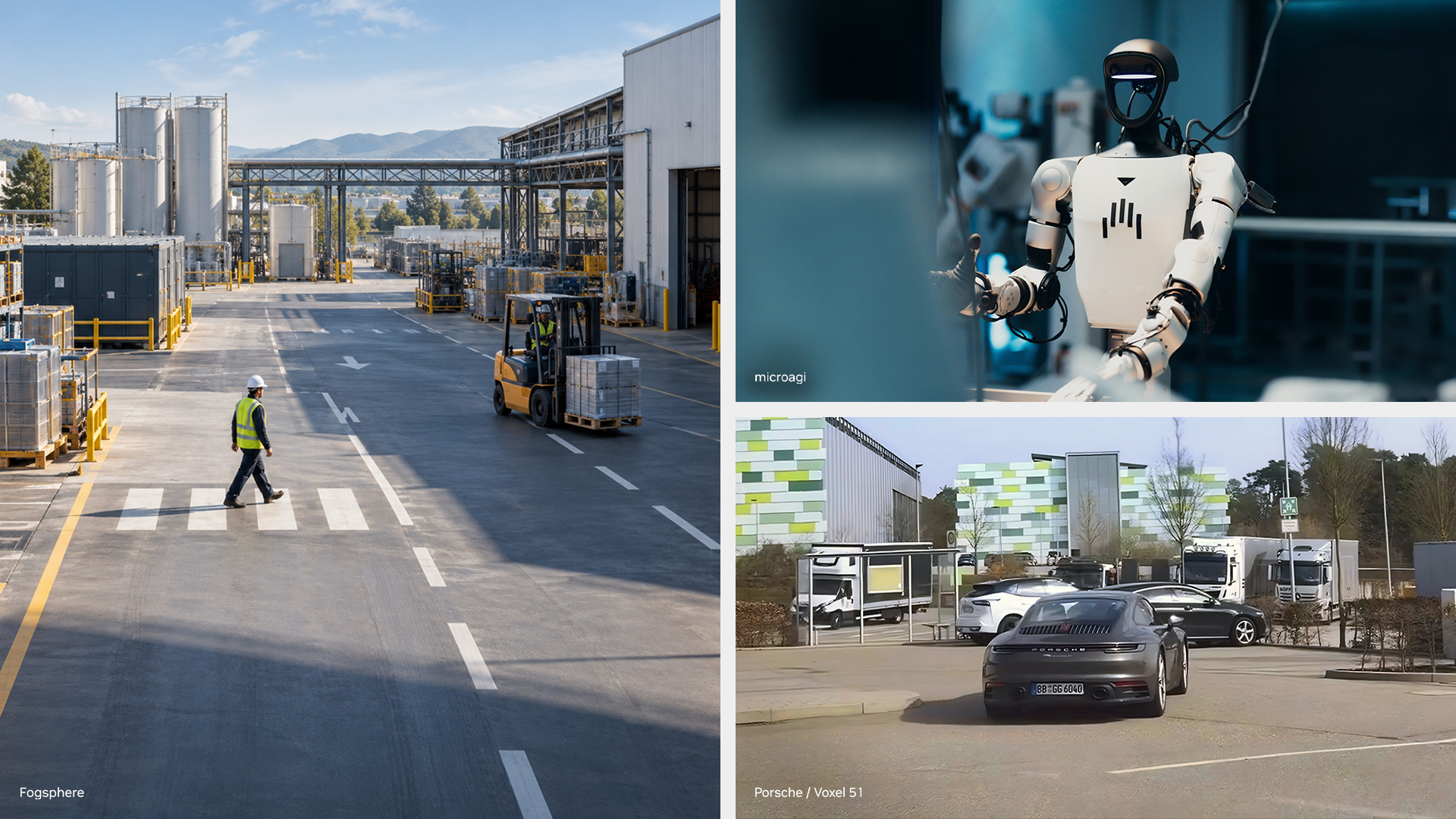
At GTC Berlin, Nvidia added five cloud data blueprints, agent-packaged training recipes, Cosmos 3 Nano checkpoints and faster inference microservices to its Cosmos world-model platform. Customer examples are concrete, but key gains are projections, and synthetic data needs real-world validation.
Key takeaways
- Cosmos gained five cloud blueprints for generating and curating training data, available via GitHub, Azure, Nebius and CoreWeave.
- Nvidia says updated inference microservices run up to twice as fast with no quality loss in validated setups.
- Porsche expects a shared Volkswagen Group data flywheel to cut repeated physical test drives by up to 90%.
- ANYbotics generated more than 1,500 synthetic clips to teach inspection robots to spot liquid spills.
- Several results, including a 32B-to-8B model distillation with no accuracy loss, are single-lab claims on Nvidia’s blog.
What Nvidia added
World models are AI systems that learn how physical scenes evolve, so robots and vehicles can predict, plan and be tested in simulation before touching the real world. Cosmos is Nvidia’s family of models and tools for that job. At GTC Berlin, Nvidia widened it with five cloud blueprints for generating and curating training data, training and optimization recipes packaged as agent skills, new Cosmos 3 Nano simulation checkpoints, and updated inference microservices that it says run up to twice as fast with no quality loss in validated setups. The data blueprints are available through GitHub, Microsoft Azure, Nebius and CoreWeave. A Metropolis video search and summarization blueprint, version 3.3, is said to let teams monitor 40% more video streams on the same GPU.
The launch sat within a keynote that pitched Europe a full AI stack, from containerized data centers to sandboxed agents (GTC Berlin keynote).
Why synthetic edge cases matter
Robots and autonomous vehicles are short of exactly the data that is hardest to collect: spills, defects, crashes, bad weather and rare hazards. The customer examples are concrete. Porsche is building a shared autonomous-driving data flywheel across Volkswagen Group brands and expects it to cut repeated physical test drives by up to 90%. ANYbotics generated more than 1,500 synthetic clips so its inspection robots learn to notice liquid spills, validating clips on Encord. ADNOC, through Fogsphere, watches for safety hazards across 65 sites and uses synthetic footage so nobody has to stage a dangerous situation to train a detector, perhaps the strongest argument for the category.
The figures should be read for what they are. ‘Expected to reduce’ is a projection, not a measured result. The claim that MicroAGI shrank a 32-billion-parameter reasoner to an 8-billion-parameter model with no accuracy loss is one lab’s result reported on Nvidia’s blog. Nvidia’s own SimReady guidance has been candid that simulated success does not guarantee real-world performance (SimReady assets).
Validation and platform gravity
Synthetic data carries a known risk: a model trained heavily on generated edge cases learns the generator’s idea of a spill or a cracked weld. If that idea drifts from reality, failures show up in the field, where stakes are highest. Validation steps like ANYbotics’ checks are the part that should become standard rather than optional, and safety regulators will increasingly ask how synthetic data feeding safety-critical systems is audited.
Nvidia describes Cosmos as modular and open, and developers can adapt outside models such as GR00T, Alpamayo, Qwen and Pi0.5. But the data factory, recipes, checkpoints and inference layer all point back toward Nvidia hardware and microservices. Competition is building: AMD agreed to buy Fei-Fei Li’s World Labs for $8.2 billion to strengthen its position in physical AI (AMD and World Labs). More in our Nvidia coverage, robotics coverage and AI tools coverage.
Who feels it
- Robotics and AV developers
- Ready-made pipelines could shorten development, if teams keep validating against real footage.
- Industrial operators
- Hazard detection trained without staging dangerous events.
- Cloud providers
- Azure, Nebius and CoreWeave become distribution points for Nvidia’s physical-AI tooling.
- Safety regulators
- Audit questions about synthetic data in safety-critical systems.
What to watch
- Measured, not projected, reductions in Volkswagen Group physical test driving.
- Independent benchmarks of Cosmos 3 Nano and distilled models.
- Validation tooling shipped alongside the data blueprints.
- Use of Cosmos recipes on non-Nvidia models.
FAQ
What is Nvidia Cosmos?
Nvidia’s platform of world models and tools for training, testing and deploying robots and autonomous vehicles.
What did Nvidia add at GTC Berlin?
Five cloud data blueprints, agent-packaged training recipes, Cosmos 3 Nano checkpoints and faster inference microservices.
Why use synthetic data for robots?
Rare, dangerous events like spills or crashes are hard and risky to film, so generated footage fills the gap.
Are the results proven?
Several are projections or single-lab results published by Nvidia, not independent measurements.
Companies: NVIDIA
More on NVIDIA
AI · Nov 5, 2026
NVIDIA’s four open Cosmos 3 Nano models let robot and driving teams simulate worlds that reactAI · Oct 7, 2026
Microsoft prices its first RTX Spark PCs; the agent sandbox coming to all Windows 11 users may matter moreAI · Nov 9, 2026
Nvidia’s Korean startup bets span interconnect, open models, robot hands and document AIAI · Nov 8, 2026
Nvidia’s Dynamo recipes speed four Korean open models to production, tuned for B200s