AI · Oct 28, 2026
RTX Spark laptops get open speech models and a dial for background agentsNvidia's new science libraries promise month-to-minutes speedups, with agents as the interface
· Updated · Signal Desk newsroom
Analysis of reporting by NVIDIA Blog. How we work
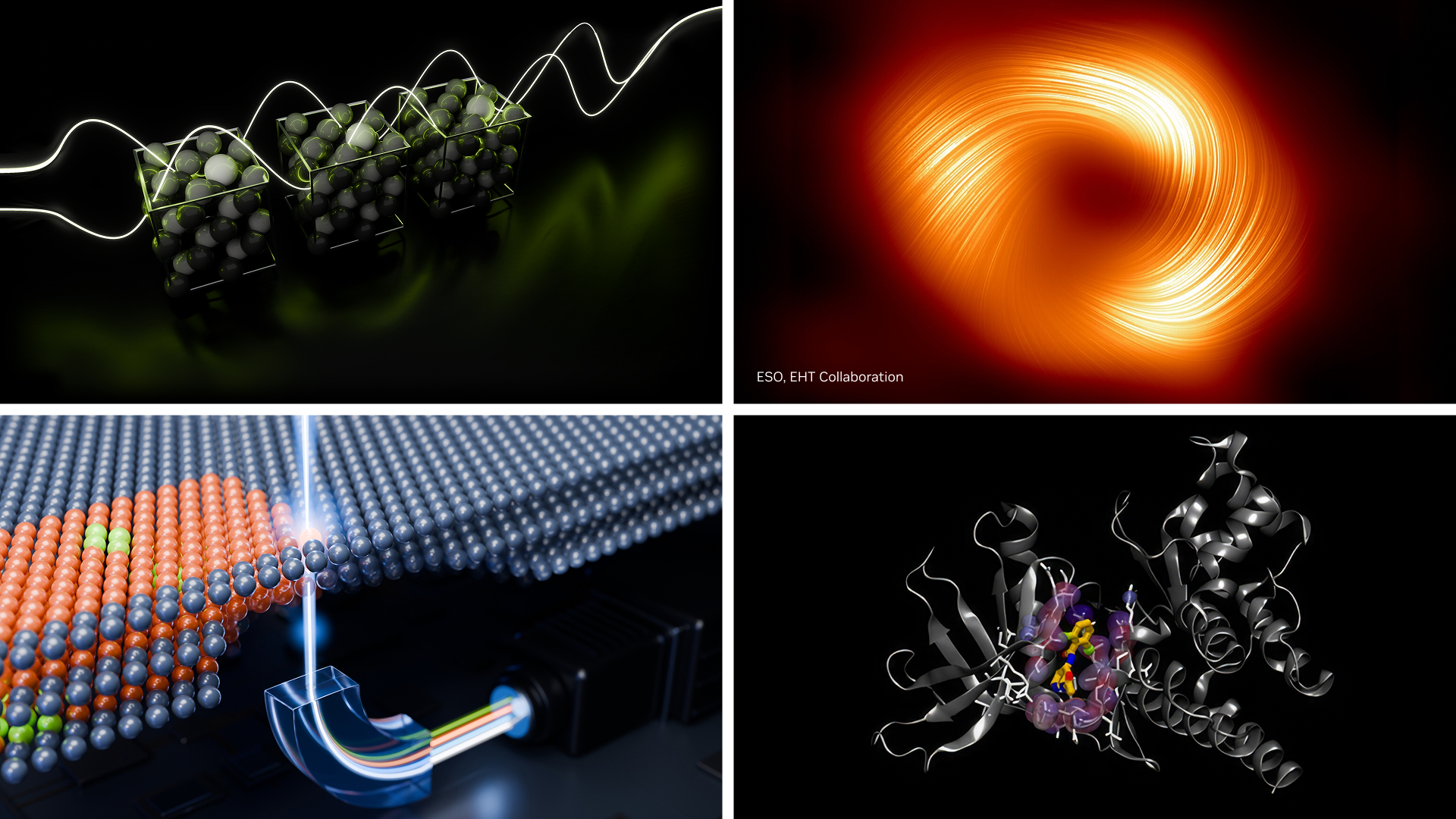
cuPhoton, cuPotential and cuSpa headline an SC26 batch of CUDA-X tools for astronomy, fusion, drug discovery and biology. The speedups are dramatic and vendor-reported, and the subtext is that scientific software increasingly runs on Nvidia's terms.
Key takeaways
- Nvidia says cuPhoton.xBeam cut Event Horizon Telescope correlation from over a month to eight minutes.
- Pacific Fusion used cuPhoton.xLens to analyze plasma simulations as they run, optionally steered by a local Nemotron agent.
- cuPotential, built on work from the Flatiron Institute and D. E. Shaw Research, accelerates molecular simulation up to 3x and is being adopted by drug discovery firms.
- Open-source cuSpa claims 900x speedups for cell polygon calculations at Memorial Sloan Kettering; rapids-singlecell and GPU HMMER report 200x and up to 84x gains.
- Daviator for VASP and DAQIRI for instrument data round out the materials push.
Science as Nvidia's next agent market
Nvidia used SC26 to expand CUDA-X, its family of GPU-accelerated libraries, with new tools aimed at astronomy, fusion, drug discovery, materials and biology. The framing is notable: the libraries are pitched not just as faster code but as tools that AI agents can call to help researchers move faster. It extends the message from Ian Buck's SC26 keynote that science is entering an agent era.
The examples are striking. With cuPhoton.xBeam, part of the cuPhoton Toolkit, Nvidia says Event Horizon Telescope black hole observations that took over a month to correlate now take eight minutes. It says the toolkit correlated observations of black hole jets J1924 and 3C279 and can run on multi-GPU systems or a compact DGX Spark. For a field where processing delays stretch for months, that kind of speedup can change how often scientists can iterate.
From fusion to medicine
In fusion, Pacific Fusion used cuPhoton.xLens to pull insights from plasma simulations while they run, instead of waiting until the end of runs that can take weeks. Nvidia says the workflow can be paired with a locally running Nemotron-powered agent for interactive analysis that helps steer simulations in real time. That is the agent pitch in its most concrete form: a model watching live scientific output and helping decide what to try next.
For drug discovery, cuPotential, based on work by researchers at the Simons Foundation's Flatiron Institute and D. E. Shaw Research, accelerates existing simulation software by up to 3x, with Nvidia also claiming better stability and accuracy. Nvidia is working with Schrödinger and the AMBER, NAMD, GROMACS, LAMMPS and Open Molecular Software Foundation communities, and Cadence, Fathom Therapeutics, Topos Bio, Genesis Molecular AI and Terray Therapeutics are adopting it. In biology, the newly open-source cuSpa claims 900x speedups over CPUs for cell polygon calculations at Memorial Sloan Kettering; rapids-singlecell helped Therna Biosciences process data 200x faster; and a GPU HMMER library ran up to 84x faster at Basecamp Research.
Materials work gets Daviator, which Nvidia says brings VASP calculations up to 22x faster at up to 75% lower cost, a claim we unpacked in our look at Daviator's k-point batching, and DAQIRI, which links a Berkeley Lab electron microscope directly to GPUs, covered in our DAQIRI analysis.
Read the multipliers carefully
Every speedup here is reported by Nvidia or its partners, and the baselines vary: CPU code, older workflows or standard implementations. A 900x gain over a CPU baseline says as much about the baseline as the library. The more durable value lies in the open-source releases, cuSpa and the GPU HMMER library, which others can inspect, benchmark and build on.
The strategic picture is clear. Each new library makes Nvidia GPUs the default substrate for another scientific discipline, and each agent-ready container pulls workflows deeper into Nvidia's stack. For researchers, that is a real gift of time. For science as a whole, it raises questions about portability and dependence on a single vendor's hardware and software choices.
Who feels it
- Astronomers
- Correlation that took a month could fit inside a coffee break, if results hold outside Nvidia's demos.
- Drug discovery teams
- Faster molecular dynamics through popular engines could expand simulation before lab work.
- Biologists
- Open-source spatial and single-cell tools lower the barrier to large-scale analysis.
- HPC centers
- More disciplines will request GPU capacity and Nvidia-specific software stacks.
What to watch
- Independent benchmarks of cuPotential inside GROMACS, AMBER and LAMMPS.
- Peer-reviewed astronomy results using cuPhoton.xBeam correlation.
- Real deployments of agents steering simulations, beyond demonstrations.
- Whether cuPhoton and cuPotential become open source like cuSpa.
FAQ
What new CUDA-X libraries did Nvidia announce?
Nvidia highlighted cuPhoton (with xBeam and xLens modules), cuPotential and the open-source cuSpa, alongside rapids-singlecell, a GPU HMMER library, Daviator and DAQIRI.
How much faster is black hole imaging with cuPhoton?
Nvidia says Event Horizon Telescope correlation that took over a month now takes eight minutes with cuPhoton.xBeam.
Which companies are adopting cuPotential?
Cadence, Fathom Therapeutics, Topos Bio, Genesis Molecular AI and Terray Therapeutics, according to Nvidia.
Companies: NVIDIA
More on NVIDIA
AI · Nov 5, 2026
NVIDIA’s four open Cosmos 3 Nano models let robot and driving teams simulate worlds that reactAI · Nov 16, 2026
Rubin HPC is Nvidia’s bet that science agents will be bottlenecked by simulation, not reasoningAI · Nov 9, 2026
Nvidia’s Korean startup bets span interconnect, open models, robot hands and document AIAI · Nov 8, 2026
Nvidia’s Dynamo recipes speed four Korean open models to production, tuned for B200s