AI · Oct 28, 2026
RTX Spark laptops get open speech models and a dial for background agentsRubin HPC is Nvidia’s bet that science agents will be bottlenecked by simulation, not reasoning
· Updated · Signal Desk newsroom
Analysis of reporting by NVIDIA Blog. How we work
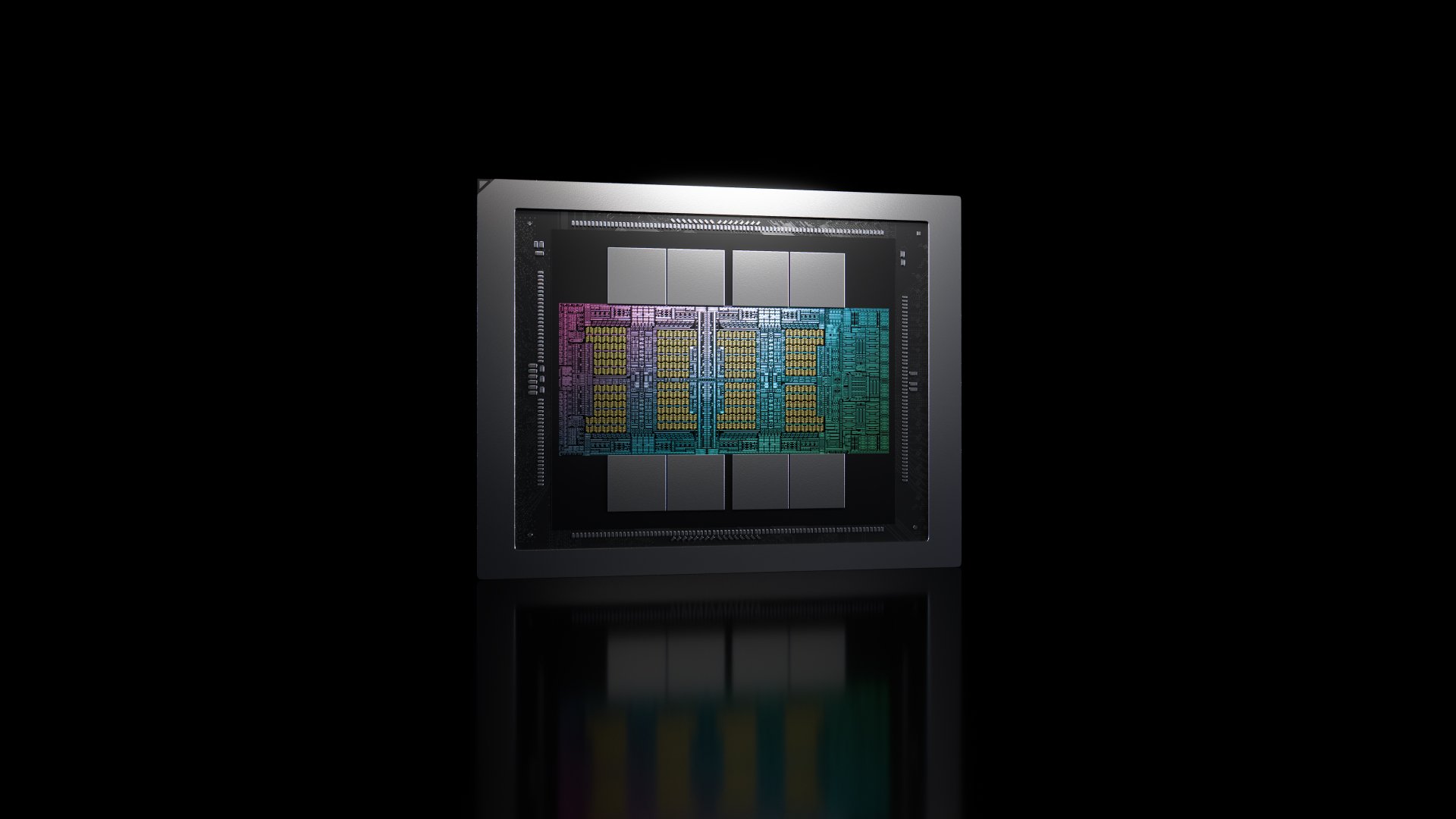
Nvidia’s new Rubin HPC GPU packs more than 50,000 CUDA cores and sparse-data acceleration aimed at simulation-heavy science. The pitch ties it to AI agents, but it won’t ship until 2028.
Key takeaways
- Rubin HPC is a new GPU in the Vera Rubin platform aimed at simulation and data processing for science, engineering and analytics.
- It has more than 50,000 CUDA cores, which Nvidia calls a record for a single GPU.
- A sparse data acceleration feature and seventh-generation NVLink are meant to keep cores fed and speed GPU-to-GPU links.
- Nvidia frames the chip around agents that generate candidates and need fast simulations to test them.
- Availability is expected in 2028; Nvidia gave no performance benchmarks or pricing in the announcement.
A chip for the other half of scientific AI
Most of the AI hardware conversation is about training and serving language models. Rubin HPC is about what happens after an agent proposes an idea. Nvidia’s argument is that as AI agents help scientists explore more candidate materials, molecules and designs, they generate more demand for the simulations that test those candidates. Faster simulation, in Ian Buck’s phrase, means faster discovery. Rubin HPC is the GPU Nvidia built for that loop.
The headline spec is more than 50,000 CUDA cores on a single GPU, which Nvidia calls a record. Equally important are the less flashy parts: a sparse data acceleration capability intended to keep those cores supplied, and seventh-generation NVLink for faster GPU-to-GPU connectivity. It joins the Vera Rubin platform, whose AI-focused NVL72 systems Nvidia just showcased in MLPerf.
Why data movement is the real story
Nvidia describes the common shape of scientific workloads well: an application reaches into a huge dataset, gathers a handful of scattered values, computes, and repeats at enormous scale. Climate models, engineering simulations, genomics and financial risk all look like that. Those workloads are often limited by memory access rather than raw arithmetic, so a GPU that adds compute alone leaves cores waiting. Rubin HPC’s balanced design is meant to scale data movement and compute together, targeting sparse matrix operations, stencil computations, sorting and reductions.
That’s the right problem to attack, and it’s a notable shift from the AI-first GPU designs of recent years, which emphasized low-precision throughput. Scientific simulation still leans on higher precision and irregular memory access, as Nvidia’s recent work on FP64 algorithms in cuBLAS acknowledges.
What we don’t know
The announcement is light on specifics. There are no performance figures against current GPUs, no memory capacity or bandwidth numbers, no power envelope and no price. The core count is the only hard spec. And availability is expected in 2028, which means this is a roadmap disclosure aimed at supercomputing centers planning procurements years ahead, not a product launch.
The agent framing deserves some skepticism too. Faster simulation would help human scientists just as much; the agent angle is how Nvidia ties scientific computing to the AI narrative that drives its valuation. That doesn’t make it wrong. Nvidia’s broader SC26 message, that science is entering an age of agents, paired with expanded CUDA-X libraries agents can call, is coherent. But the chip’s value will be judged on simulation throughput, whoever submits the jobs.
Who it affects
- Supercomputing centers
- A dedicated simulation GPU to plan around for 2028-era systems.
- Computational scientists
- Potentially faster sparse and stencil workloads, if the data-movement design delivers.
- Industrial engineering firms
- Faster design simulation loops for materials, molecules and products.
- Competing HPC chipmakers
- Nvidia signals it will contest simulation-heavy markets with a purpose-built part.
What to watch
- Detailed specs: memory capacity, bandwidth, FP64 performance and power.
- The first supercomputer procurements naming Rubin HPC.
- Benchmarks on sparse and stencil workloads versus current Nvidia GPUs.
- Whether the 2028 timeline holds amid Nvidia’s leadership transition.
FAQ
What is Rubin HPC?
A new Nvidia GPU in the Vera Rubin platform designed to accelerate simulation and data processing for science, engineering and analytics.
What’s notable about it?
More than 50,000 CUDA cores, sparse data acceleration and seventh-generation NVLink, according to Nvidia.
When will it be available?
Nvidia expects availability in 2028.
Why does Nvidia link it to agents?
Nvidia argues AI agents will generate more candidate designs that need fast simulations to test, making simulation speed a bottleneck.
Companies: NVIDIA
More on NVIDIA
AI · Nov 5, 2026
NVIDIA’s four open Cosmos 3 Nano models let robot and driving teams simulate worlds that reactAI · Nov 9, 2026
Nvidia’s Korean startup bets span interconnect, open models, robot hands and document AIAI · Nov 8, 2026
Nvidia’s Dynamo recipes speed four Korean open models to production, tuned for B200sAI · Nov 5, 2026
Nvidia profiles Chris Alexiuk, the YouTube teacher making the case that open AI means weights, data and recipes