AI · Nov 9, 2026
OpenAI’s Control Room puts a fail-closed kill switch inside the inference engineInside OpenAI’s forward-deployed engineering: embed, ship, then feed the lab
· Updated · Signal Desk newsroom
Analysis of reporting by OpenAI. How we work
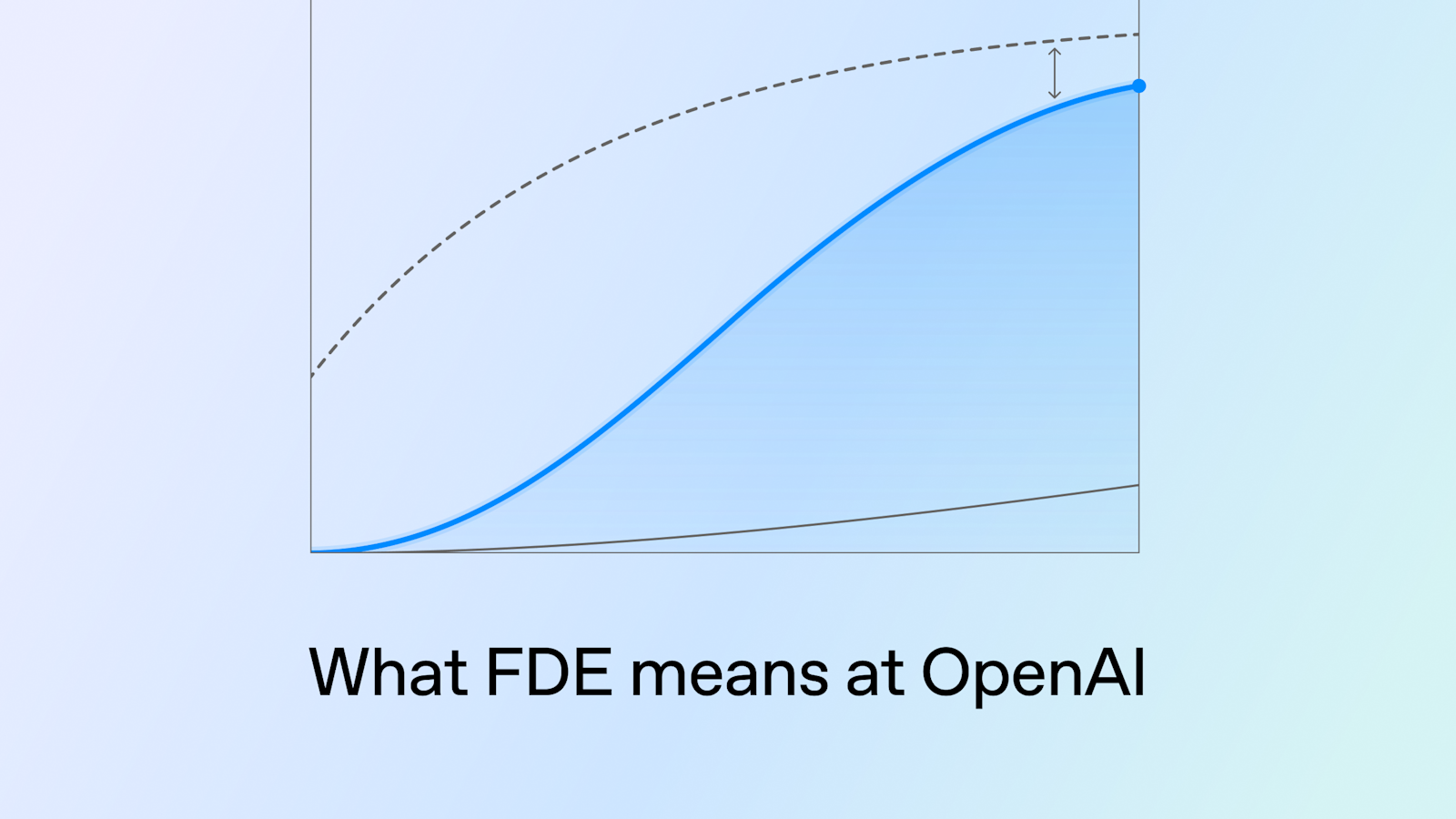
Colin Jarvis, who leads OpenAI’s Forward Deployed Engineering team, describes engineers embedding with customers, shipping hard problems to production, folding reusable work into products and routing unsolved problems to Research. The figures are OpenAI’s own; the structural advantage is real.
Key takeaways
- Jarvis says he founded the team in early 2025 to close the ‘deployment gap’ between what models seem able to do and what people can reliably use.
- OpenAI reports about 48% time saved on directed test generation for an unnamed semiconductor customer, with debugging cut from weeks to hours.
- When Codex matured, the team says it removed about 90% of the custom code per project.
- A telecom customer’s voice-support evaluation scores reportedly rose from about 60% to more than 90% after six months of Research work.
- All figures are OpenAI’s claims about its own customers, several of them unnamed.
What OpenAI described
Colin Jarvis, head of Forward Deployed Engineering at OpenAI, has laid out how the team works in a company post. Engineers embed with a customer, get a hard problem into production, fold whatever is reusable into products such as Codex, and send problems the models cannot yet solve back to OpenAI’s Research group. Jarvis says he founded the team in early 2025 to close what OpenAI calls the deployment gap, the space between what models appear able to do and what people can reliably use at work. His slide motto is to start with the outcome and scale later, which he pairs with an acknowledgment that the industry is prone to hype.
The post traces OpenAI Presence, its enterprise voice and chat agent product, back through these field deployments and earlier projects such as Swarm and the Agents API. It also cites John Deere using OpenAI’s APIs to give farmers personalized guidance on its See & Spray weed-control system, which the post says can cut chemical use by up to 70%.
The numbers, and their limits
The examples carry specific figures. With a large semiconductor customer, about 15 engineers worked on more than ten verification use cases in 2025; OpenAI reports roughly 48% time saved on directed test generation and debugging that shrank from weeks to hours. After Codex matured, the team says it removed about 90% of the custom code per project, and extending one deployment to a second team took a day after the first took two months. With Thrive Holdings, a tax tool processed 7,000 returns in its pilot and lifted throughput about 50%.
These are OpenAI’s figures about its own customers, and the semiconductor and telecom customers are unnamed, so they are best read as vendor claims rather than audited results. Independent confirmation from named customers would carry more weight. The broader distribution picture is also shifting: OpenAI models are coming to Google Cloud’s Model Garden in private preview (OpenAI on Google Cloud), which widens how enterprises can buy them without an embedded team.
A feedback loop competitors cannot easily copy
The telecom case shows the mechanism. The model scored around 60% on the customer’s key evaluations for voice support; OpenAI told the customer, brought in Research, and over six months scores rose past 90%. The resulting voice model now serves other customers too. That is a productive loop, and also a structural advantage: a frontier lab placing engineers inside major companies, learning their hardest workflows and turning that into model improvements that pure API vendors without such access struggle to match. For buyers, it raises practical questions about dependence, how data and learnings from embedded work are governed in contracts, and who captures the value created.
There is a labor dimension as well. One customer now handles more than half its calls with AI, and the telecom work targeted voice, which made up around 90% of that company’s service volume. Efficiency gains for the company can mean fewer contact-center jobs and customers routed to machines they did not choose. OpenAI’s speed work on inference for agent loops (Astra Ultrafast) will make voice agents cheaper still. More in our OpenAI coverage, enterprise coverage and future of work coverage.
Who feels it
- Enterprises
- A template of evaluating first and scaling what works, with heavy embedded engineering behind it.
- Competing AI labs
- Field work that feeds model training is a moat API-only businesses struggle to copy.
- Customer-service workers
- Production-grade voice agents put the largest share of contact-center volume within reach of automation.
- Engineers
- Value shifts from writing code to understanding a customer’s domain.
What to watch
- Named customers independently confirming time-savings and throughput figures.
- How data from embedded engagements is governed in OpenAI contracts.
- Presence voice agents moving into regulated industries.
- Rivals building similar embedded engineering teams.
FAQ
What is forward-deployed engineering at OpenAI?
A team of engineers who embed with customers to get AI into production, turn reusable work into products and send unsolved problems to Research.
Who leads it?
Colin Jarvis, who says he founded the team in early 2025.
Are OpenAI’s reported results verified?
No. The figures are OpenAI’s own claims, and several customers are unnamed.
Which OpenAI product grew out of this work?
OpenAI Presence, its enterprise voice and chat agent product, according to the post.
Companies: OpenAI
More on OpenAI
AI · Oct 21, 2026
OpenAI on Google Cloud lets companies spend Google commitments on GPT-6, and that changes procurementAI · Oct 14, 2026
White Circle says newer OpenAI and Google image models are easier to jailbreak than their predecessorsAI · Oct 19, 2026
Microsoft ships Guardian Agents, saying frontier models ‘can’t be trusted’AI · Oct 13, 2026
After months off the frontier, Google ships Gemini 4 Argon with benchmark claims and aggressive pricing