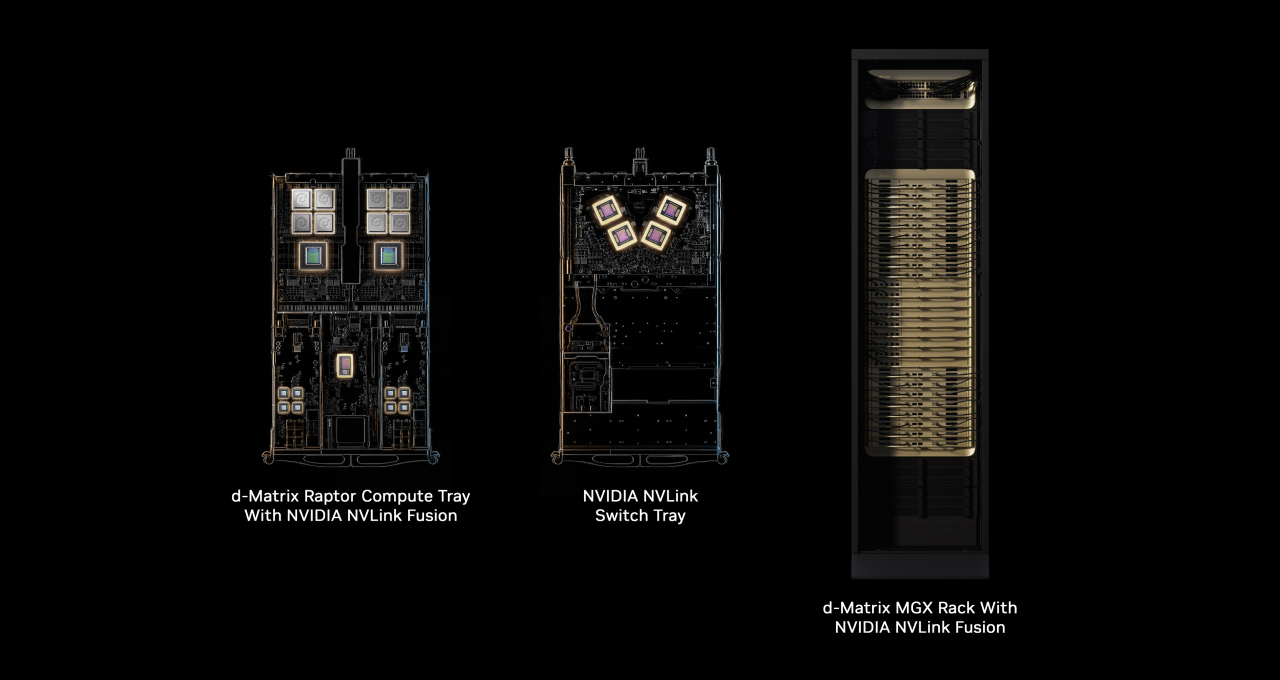
d-Matrix Adopts NVIDIA NVLink Fusion for Rack-Scale XPU Deployment
Inference chipmaker d-Matrix is plugging next-gen Raptor XPUs into NVIDIA’s NVLink Fusion stack — betting that rack-scale deployment, not just silicon, is the bottleneck.
Desk
NVIDIA hardware, software, and developer news.

Inference chipmaker d-Matrix is plugging next-gen Raptor XPUs into NVIDIA’s NVLink Fusion stack — betting that rack-scale deployment, not just silicon, is the bottleneck.

NVIDIA is post-training a compact Nemotron model on real allocation decisions so wafer-to-rack judgment stops living only in planners’ heads.

NVIDIA’s Dynamo guide shows when peeling vision encode off prefill and decode pays off—and when long outputs make the trick a wash.

CUDA 13.4 brings Windows on Arm, early Rubin hooks, and MPS V3 controls that treat shared GPUs more like programmable infrastructure than a free-for-all.

At IBC 2026, NVIDIA is packaging authenticity detectors, frame generation, and sports-specific fine-tuning into one media stack—pushing live production toward software-defined AI without pretending the trust problem is solved.

NVIDIA opens two official Rust paths to native PTX kernels—SIMT via cuda-oxide and Tile via cutile-rs—betting the AI systems stack will keep migrating to Rust.

NVIDIA's open recipe separates evidence, a Markdown self model, and a SQLite judgment ledger—then shows structured memory beating agentic RAG where facts drift over time.

NVIDIA argues 2026 open reasoning models finally fit Jetson — if you pick MoE versus dense carefully and stop treating speculative decoding as one-size-fits-all.

Cook hands Apple to hardware chief Ternus days before a phone event, while Nvidia keeps buying and funding its way up the AI stack. Two succession stories, one about products and one about power.

NVIDIA describes a central identity gateway that owns platform sessions while regional Kubernetes gateways only enforce — cutting repeated logins 55% across AWS and OCI clusters.

Nvidia's IFA blog is a vendor catalog: PAIR, RTX Spark in October, one-click local agents, and a stack of open models that all happen to run on Nvidia silicon.

Nvidia's developer post is the honest PAIR document: it is a proxy, not a cluster, and it does not pool VRAM. The 8-minute demo is unofficial on purpose.